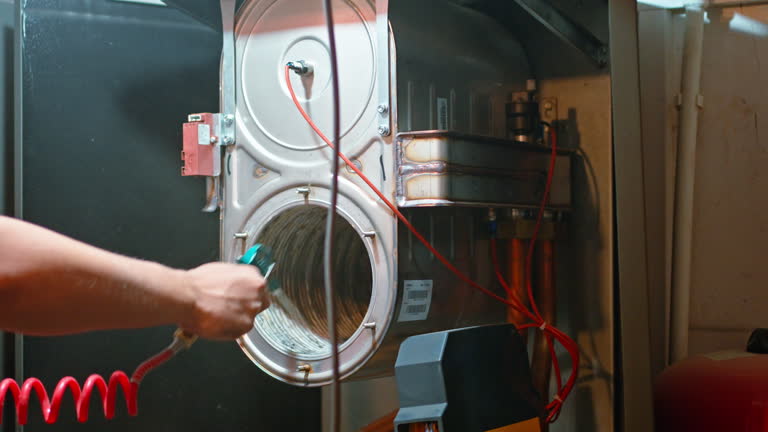

A heat exchanger rarely loses performance all at once. More often, the change develops gradually: outlet temperature drifts, a control valve opens farther than it once did, pressure loss increases, or a process takes longer to reach its target condition. Because production may continue, these changes can become accepted as normal until they begin affecting capacity, energy use, or product consistency.
That makes operating data one of the most useful tools for identifying developing heat exchanger problems. Facilities that establish a healthy-performance baseline and monitor a small group of related measurements can often recognize deterioration before it causes an unplanned shutdown.
Establish a Baseline Before Performance Changes
Current readings are difficult to interpret without something meaningful to compare them against. A heat exchanger’s design sheet provides important information, but actual operating conditions may differ from the original assumptions. Production rate, product properties, utility temperatures, and control settings can all change after installation.
A practical baseline should reflect the exchanger when it is known to be operating well. Useful measurements may include:
- Hot- and cold-side inlet temperatures
- Hot- and cold-side outlet temperatures
- Flow rates on both sides
- Pressure at the inlet and outlet of each circuit
- Control-valve position
- Pump speed or load
- Time required to heat or cool the process
- Product type, recipe, or operating mode
Recording the process conditions alongside the measurements matters. A higher outlet temperature may be expected when the product enters warmer, for example, while the same change under comparable conditions could indicate a developing performance problem.
Temperature Drift Is Only One Signal
Failure to reach the target outlet temperature is an obvious warning, but it is often a later-stage symptom. The control system may compensate for declining heat transfer by increasing utility flow, changing valve position, or extending processing time.
The process can therefore appear stable while using more steam, hot water, chilled water, or refrigeration capacity than it once required. This is why a single temperature reading does not provide the complete picture.
Comparing temperature, flow, valve position, and production rate together can reveal whether the system is working harder to produce the same result. If the control valve once operated at 55 percent and now remains near 85 percent during an equivalent run, the change deserves investigation even if the final product temperature is still acceptable.
Pressure Trends Can Indicate Restricted Flow
Deposits can narrow internal flow passages and increase resistance. As that occurs, the pressure difference from the exchanger inlet to its outlet may increase.
Pressure data is most valuable when measurement locations remain consistent and readings are compared at similar flow rates. Pressure drop naturally changes with flow, so an isolated reading can be misleading. A rising pressure differential under comparable operating conditions provides a stronger indication that the flow path may be becoming restricted.
Facilities should also consider other possible causes. A valve in the wrong position, a clogged upstream strainer, a pump problem, or an inaccurate instrument can produce similar symptoms. The goal is not to diagnose the exchanger from one number but to use several measurements to narrow the investigation.
Different Products May Create Different Patterns
An exchanger may perform normally during one recipe and struggle during another. Product viscosity, solids content, concentration, and temperature sensitivity can influence both heat transfer and the rate at which material accumulates on internal surfaces.
Instead of averaging all production data together, facilities may gain more useful information by separating it according to product family or operating mode. This can reveal whether performance declines after a certain number of batches, during a particular recipe, or under specific temperature conditions.
These patterns can help maintenance and operations teams move from a calendar-only approach toward cleaning intervals informed by actual process behavior.
Avoid Waiting for a Production Failure
There is a difference between detecting a change and waiting until the exchanger can no longer meet production requirements. If intervention occurs only after the process falls outside specification, the facility has little flexibility in scheduling downtime.
Earlier warning signs create options. Maintenance can be coordinated with a planned outage, replacement parts can be obtained in advance, and the facility can determine whether the problem calls for inspection, testing, or heat exchanger cleaning.
The appropriate response depends on exchanger design, process conditions, construction materials, deposit type, and manufacturer guidance. Cleaning chemicals or procedures should not be selected solely because they worked elsewhere; an unsuitable method can damage plates, tubes, gaskets, or other components.
Review Performance After Maintenance
Post-maintenance data helps confirm whether the work corrected the problem. Compare the exchanger’s temperature approach, pressure differential, valve position, and cycle time with the pre-maintenance condition and the original healthy baseline.
If performance does not recover as expected, the cause may extend beyond surface deposits. Possible issues include damaged heat-transfer surfaces, internal leakage, incorrect assembly, reduced utility capacity, flow-distribution problems, or inaccurate instrumentation.
This comparison also improves future planning. If the same operating pattern appears before each intervention, the facility can use that trend as an early warning for subsequent maintenance cycles.
Turn Readings Into a Repeatable Condition Review
Collecting large volumes of data is not the objective. The value comes from consistently reviewing the measurements that reflect heat-transfer performance, hydraulic condition, and the effort required to maintain the process target.
A simple condition review can ask:
- Is the exchanger achieving the same thermal result at a comparable production rate?
- Has pressure loss changed at a similar flow rate?
- Is the control system using more utility capacity to compensate?
- Does deterioration correlate with a specific product or operating condition?
- Did performance return after the last maintenance event?
When these questions become part of routine operations, gradual deterioration is less likely to remain hidden. The result is a more informed maintenance schedule, better control over energy use, and more opportunity to address problems before they interrupt production.