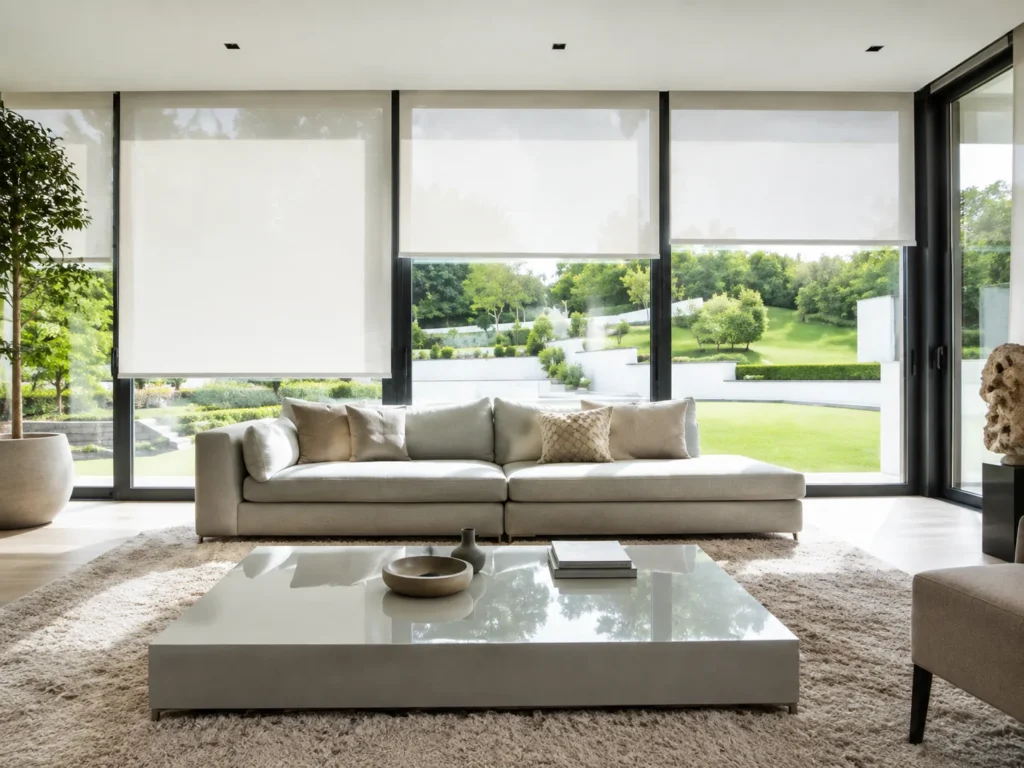

Small rooms do not necessarily need fewer design ideas; they need better control over scale, contrast and visual interruption. The window is central to that balance because it determines how much daylight enters the room and how much of the wall is occupied by frames, blinds, curtains and surrounding furniture.
A poorly proportioned window treatment can make a compact space feel busier than it is. Too much fabric, heavy pattern or an awkward stack at the top of the window can reduce the sense of openness. A simpler, better-scaled approach can do the opposite: keep attention on the room itself, preserve useful daylight and allow the window to feel like part of the architecture rather than an obstacle.
Start by protecting the daylight you already have
In a small room, natural light is valuable because there is less physical space for the eye to move through.
That does not mean the window must remain completely uncovered, but it does mean every part of the treatment should justify the space it occupies.
Look at how much glass is visible when the blind is fully open. If a large amount of material remains gathered at the top, a modest window can appear smaller and the room may lose useful daylight.
This matters particularly in:
- box bedrooms;
- compact studies;
- small dining rooms;
- narrow living rooms;
- converted loft rooms;
- and spare rooms with a single window.
The more limited the glazing, the more important it becomes to preserve its visual contribution.
Scale matters more than decoration
One of the easiest mistakes in a small room is choosing a design that looks attractive on a sample but becomes oversized once installed.
A large repeat pattern may dominate a narrow window. Heavy horizontal detailing can make a short wall feel busier. Strong contrast between the blind and the surrounding wall can turn the window into the most visually demanding element in the room.
None of these choices are inherently wrong, but scale becomes less forgiving when space is limited.
A useful test is to step back and imagine the blind occupying the full window rather than looking at a small piece of fabric close up.
For homeowners considering withington blinds for a compact room, judging samples from the doorway rather than only at the window can give a much clearer sense of whether the treatment feels proportionate.
Keep the wall around the window visually calm
Small rooms often contain a lot within a limited area: shelving, wardrobes, radiators, desks, side tables and storage.
If the window treatment introduces another strong shape, colour or pattern, the wall can quickly feel crowded.
A calmer approach does not require everything to match. It simply helps if the blind relates closely enough to the wall and frame that the window does not appear visually boxed in.
Similar tones can soften the transition between wall and blind. A slightly deeper shade can still add definition without creating a hard edge.
Where the room already contains several pieces of furniture close to the window, visual restraint at the glass can make the entire elevation feel less cluttered.
Avoid making the blind wider in visual terms than the window itself
The eye does not only register the physical dimensions of a blind; it also responds to its colour, pattern and contrast.
A dark blind on a pale wall can appear heavier and broader than a pale treatment of the same size. A bold stripe can exaggerate width. A dense pattern can make the window feel more substantial than the architecture actually is.
Sometimes that effect is useful, particularly if a small window needs stronger presence.
But if the aim is to make the room feel open, it is usually better to avoid visual weight that exceeds the scale of the opening.
The blind should frame the window rather than make it feel larger and heavier than the rest of the wall can comfortably support.
Use pattern carefully, not fearfully
Pattern is often avoided in small rooms because of the belief that it automatically makes them look smaller.
That is too simplistic.
Pattern can work very well if its scale and contrast suit the room. A fine stripe, small geometric design or subtle botanical motif can add personality without taking over.
The problem usually arises when several competing patterns occupy the same visual field.
If the room already has patterned bedding, a busy rug and artwork, a heavily patterned blind may create too many focal points. If the rest of the space is restrained, the window can take on more decorative responsibility.
Think in terms of hierarchy rather than rules. Decide where the eye should go first and let the remaining elements support that decision.
Small rooms benefit from fewer hard visual stops
Every sharp contrast creates a visual boundary.
A very dark blind against a pale wall, a bright white frame against deep paint or a strong patterned treatment beside plain furniture can all make the room feel divided into smaller sections.
That can be attractive when used deliberately, but it is not always helpful in a compact space.
A more continuous palette allows the eye to travel across the room with fewer interruptions.
This is especially useful in narrow spaces where the window occupies one end of the room. A treatment that blends more naturally with the wall can help the space feel longer and less abruptly terminated.
Householders looking at newhey blinds for a smaller bedroom or study can use wall colour and flooring as the starting point, then choose a blind that supports the room’s existing visual flow rather than introducing an unrelated contrast.
Consider the window from the main entrance to the room
The first view into a compact room matters.
If the window is directly opposite the doorway, it immediately becomes part of the room’s visual depth. Keeping the treatment relatively clean and allowing enough daylight through can help draw the eye towards the far wall.
If the blind is bulky, dark or visually complicated, that same window can instead become a stopping point.
Stand in the doorway and ask:
- Does the window feel open?
- Is the blind the first thing you notice?
- Does the treatment frame the view or block it?
- Does it make the far wall feel closer?
- Does the room look calmer when the blind is raised?
This perspective is often more useful than assessing the blind from close range.
Furniture placement can make a window feel smaller
Sometimes the blind is not the real problem.
A large desk pushed across the window, a tall plant, shelving or bulky furniture can reduce the amount of visible glazing and make the room feel darker.
Before choosing a window treatment, look at what surrounds the opening.
If possible, keep the immediate area relatively clear. Even a small amount of breathing space around the frame can make the window feel more generous.
This does not mean furniture must be pulled away entirely. In a compact room that may be unrealistic. But avoiding unnecessary overlap can make both the window and blind feel better proportioned.
Let the outside view extend the room visually
A window can make a small room feel larger by providing depth beyond the walls.
Even an ordinary view can contribute to that effect. Trees, rooftops, sky or neighbouring gardens give the eye somewhere further to travel.
A blind that allows the view to remain present during the day can therefore support the sense of openness.
The window treatment does not need to disappear entirely, but it should avoid unnecessarily cutting off that depth where privacy allows.
In rooms where the external view is pleasant, the blind can work more successfully as a frame than as a feature in its own right.
Privacy should be solved as precisely as possible
Small rooms often face a dilemma: they need privacy, but covering the entire window all day can make them feel noticeably darker.
The better approach is to identify when and where privacy is actually needed.
A first-floor room may have little daytime overlooking. A ground-floor room facing a pavement may need more consistent screening. A side window may require privacy only from one neighbouring property.
The more precise the problem, the easier it becomes to avoid over-covering the glazing.
For someone considering blinds bradford city centre for a compact urban room, surrounding buildings and direct sightlines may matter as much as the size of the window itself.
The goal is to create enough privacy without removing more daylight than necessary.
Think about the blind in its most common position
Window treatments are often chosen by looking at photographs of them fully closed.
But in everyday life, that may not be how they are seen most often.
A small living room may keep the blind open all day and close it only in the evening. A home office might use it partially closed during certain hours. A bedroom may be the opposite.
The position seen most frequently should influence the design choice.
If the blind is usually raised, its stack and headrail matter greatly. If it is commonly closed, colour, texture and visual weight become more important.
Choosing for the everyday position produces a more accurate sense of how the room will actually feel.
Use colour to support space rather than simply lighten it
Light colours can help a room feel airy, but pale does not automatically mean spacious.
A very bright white blind can create a harsh contrast against warmer walls, making the window feel more defined rather than less. A slightly deeper neutral that relates to the rest of the room may actually create a smoother, more expansive effect.
Likewise, darker blinds are not automatically unsuitable.
In a room with deep wall colours, a blind in a similar tone can reduce contrast and make the window feel integrated. The result may feel more cohesive than inserting a pale rectangle into an otherwise enveloping scheme.
The important factor is the relationship between colours, not simply how light or dark they are individually.
Texture can add depth without adding clutter
Small rooms still need character.
If strong pattern feels too busy, texture can provide interest more quietly.
A woven appearance, soft fabric-like surface or subtle material variation can prevent a neutral blind from feeling flat without introducing another graphic element.
This is particularly useful where the room already contains several hard surfaces such as painted furniture, laminate flooring, mirrors or desks.
Texture can soften the room without visually reducing it.
Viewed from a distance, it adds depth rather than demanding attention.
Keep several windows consistent where the architecture repeats
If a small room has two similar windows, treating them very differently can fragment the space.
Repeated openings generally benefit from a related treatment because repetition creates order.
That does not necessarily mean every detail must be identical, but obvious differences in colour, height or visual weight can make a compact room feel more complicated.
Where the windows are part of the same wall, alignment becomes especially important.
A consistent top line and similar amount of visible material when open can make the architecture feel cleaner and more deliberate.
Do not let controls add unnecessary visual noise
Blind controls are practical details, but in a small room they may be more visible simply because everything is closer together.
Their location should therefore be considered alongside furniture and the window itself.
A control that hangs awkwardly over a desk or sits beside a visually busy shelf can contribute to clutter. More importantly, it should remain easy to reach and should not conflict with furniture or window movement.
The neatest-looking arrangement is not useful if it becomes awkward to operate.
Good small-room design depends on keeping practical details simple rather than hiding them at the expense of usability.
Use mirrors carefully around the window
Mirrors can help distribute light around a small room, but placement matters.
Positioning a mirror where it can reflect part of the window may increase the sense of brightness and depth. However, placing a large mirror directly opposite intense sunlight can create uncomfortable glare at certain times.
The blind and mirror should therefore be considered together.
If the room relies on reflected daylight, a treatment that preserves a reasonable amount of natural light may support that effect better than one that routinely covers most of the glazing.
Again, the principle is not to maximise light at all costs, but to use the available light intelligently.
Avoid overcrowding the window with too many layers
Layered window treatments can look beautiful, but they introduce more material.
In a generous room, that may add softness and richness. In a very small room, heavy layering can make the wall feel crowded, particularly if curtains, pelmets or substantial hardware extend beyond the window.
If layering is desired, keep the proportions disciplined.
A simple blind with lightweight curtains may work better than several visually heavy treatments competing for limited wall space.
The room should still feel as though the window has room to breathe.
Assess the blind from across the whole room
A common mistake is making the final decision while standing a few centimetres from the sample.
Small rooms are experienced at short distances, but the window still needs to work as part of the whole composition.
Place the sample at the window and move to the opposite side of the room.
Look at how it relates to:
- the wall colour;
- flooring;
- largest pieces of furniture;
- bedding or upholstery;
- storage;
- and the amount of exposed glazing.
The best choice may be the one that initially seems least dramatic but makes the room feel most balanced when everything is seen together.
A practical checklist for compact rooms
Before choosing the final window treatment, consider:
- How much glass remains visible when the blind is open?
- Does the blind look too large for the window?
- Is the pattern appropriately scaled?
- Does the colour create unnecessary contrast?
- Can the external view contribute to the sense of depth?
- Is daytime privacy genuinely required across the entire window?
- Does nearby furniture block light or access?
- Is the control easy to reach without adding clutter?
- Does the blind work with the room’s main sightline?
- Would texture provide enough interest without stronger pattern?
- Are several windows visually aligned?
- Does the window still feel generous when the treatment is fitted?
These questions are often more useful than simply asking which blind type is recommended for a small room.
Make the window feel lighter, not busier
Making a compact room feel more open is less about following a fixed set of decorating tricks and more about reducing unnecessary visual weight.
A well-scaled blind can preserve daylight, keep the wall around the window calm and allow the eye to move beyond the room rather than stopping at the glass.
The most successful choice will not necessarily be the palest or simplest option available. It will be the one that respects the proportions of the window, works with the room’s colour palette and gives the glazing enough space to contribute to the room rather than compete with it.
Frequently Asked QuestionsDo light-coloured blinds always make a small room look bigger?
No. Light colours can help create an airy appearance, but contrast matters just as much. A pale blind that strongly clashes with the wall can make the window feel more visually prominent. A related mid-tone may sometimes create a smoother and more spacious effect.
Are patterned blinds unsuitable for small rooms?
Not necessarily. Small-scale or low-contrast patterns can work very well. The important considerations are scale, the amount of pattern already elsewhere in the room and whether the blind becomes too dominant once installed across the full window.
Should a blind sit inside or outside the recess in a small room?
That depends on the window, recess depth, handles, fixing surfaces and how much glazing you want to keep visually exposed. Neither position is automatically better for small spaces. The best choice is the one that fits properly and preserves practical use of the window.
Can darker blinds work in a compact bedroom or study?
Yes. Darker colours can look cohesive and sophisticated, particularly where the walls or furniture are also deeper in tone. What matters is avoiding unnecessary visual heaviness or contrast rather than avoiding dark colours altogether.
What is the most important window-styling consideration in a small room?
Preserving proportion is usually more important than following a specific style rule. The blind should suit the scale of the window, keep access straightforward and avoid blocking more daylight or visible glass than the room can comfortably afford.