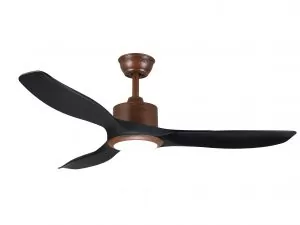

No appliance is more central to everyday comfort in a Singapore home than the ceiling fan. Air-conditioning addresses extreme heat but at significant energy cost; a ceiling fan running at moderate speed creates sufficient air movement to raise the effective comfort temperature by 3 to 4 degrees Celsius, allowing the aircon set point to be raised or switched off entirely during cooler periods. The cumulative effect on electricity bills over a year is substantial.
But choosing the wrong fan — wrong size, wrong motor type, wrong mount for the ceiling height — is a common and expensive renovation mistake. This guide provides a room-by-room specification framework for Singapore HDB flats and condominiums.
Bedroom
The bedroom is where ceiling fan noise matters most. For standard HDB bedrooms (10 to 15 sqm), a blade span of 42 to 48 inches is appropriate. DC motor fans are strongly recommended for bedroom installations: they are typically 60 to 70 percent quieter than equivalent AC motor models and consume 15 to 35 watts versus 50 to 80 watts for AC. For bedrooms with ceiling heights below 2.7m, a hugger mount (flush mount without a down rod) is essential to maintain the minimum 2.1m floor-to-blade clearance required by safety regulations. Many homeowners in this situation choose ceiling fan with lights Singapore models to eliminate the need for a separate ceiling light point — particularly useful in HDB bedrooms where the ceiling fan point and light point are often the same electrical outlet.
Master Bedroom
Master bedrooms in Singapore condominiums and landed properties typically range from 15 to 25 sqm, requiring a blade span of 48 to 56 inches. This is where the investment in premium DC motor technology is most justified: the fan runs for more hours than any other appliance in the home, the noise level directly affects sleep quality, and the energy saving over a ten-year lifespan is significant. Point One ceiling fans with Japanese ball bearing EC motors are consistently specified for master bedrooms by interior designers who prioritise near-silent operation — the difference between a Point One motor at full speed and an AC motor fan at equivalent airflow is audible in a quiet room.
Living Room
Singapore HDB living rooms (20 to 30 sqm) require a blade span of 52 to 56 inches for adequate air circulation. Living room ceiling fans are display items as much as functional appliances — they are visible from the entrance, often the focal point of the ceiling, and their finish and blade profile contribute to the overall interior aesthetic. For living rooms with feature lighting (cove strips, pendant lights), a fan without an integrated light kit allows the lighting scheme to remain independent and flexible.
Ceiling heights in many Singapore living rooms, particularly in older HDB blocks, are 2.7m or below — sufficient for a standard mount with a very short down rod (150 to 200mm), but not for a full-length rod. Always measure ceiling height before specifying the mount type.
Kitchen and Service Areas
Singapore kitchen and service areas present a specific challenge: limited ceiling area, proximity to heat and cooking fumes, and the need for a compact, easy-to-clean fixture. Blade spans of 36 to 42 inches are appropriate for most HDB kitchens. AC motor fans are a practical and cost-effective choice for kitchen service — the lifespan reduction from AC motor technology is acceptable in a lower-usage secondary space, and the lower price point reflects the lower priority relative to bedroom and living room installations.
Brand Guide by Room
Fanco ceiling fans offer the widest range across Singapore’s most common installation scenarios: the Co-Hugger for low-ceiling HDB bedrooms, the B-Star for budget-conscious secondary rooms, and the Rito for design-forward living room applications. Alaska’s Evora Jett is the specification choice for large master bedrooms and premium condo installations where maximum blade span and minimum noise are the priorities. Efenz fans occupy the design premium segment, with sculptural blade profiles suited to contemporary and Japandi-influenced interiors where the fan is intended as a design statement.
What to Do Next
The most important step in ceiling fan selection is experiencing the airflow and noise level of different models before committing to purchase. Specifications and reviews convey information about a fan; standing beneath it at operating speed conveys the reality. Homeowners can explore the full ceiling fan Singapore range at Regal Lighting Gallery, where every brand and model runs live on display, allowing direct comparison of airflow, noise level, and light kit performance before any purchase decision is made.