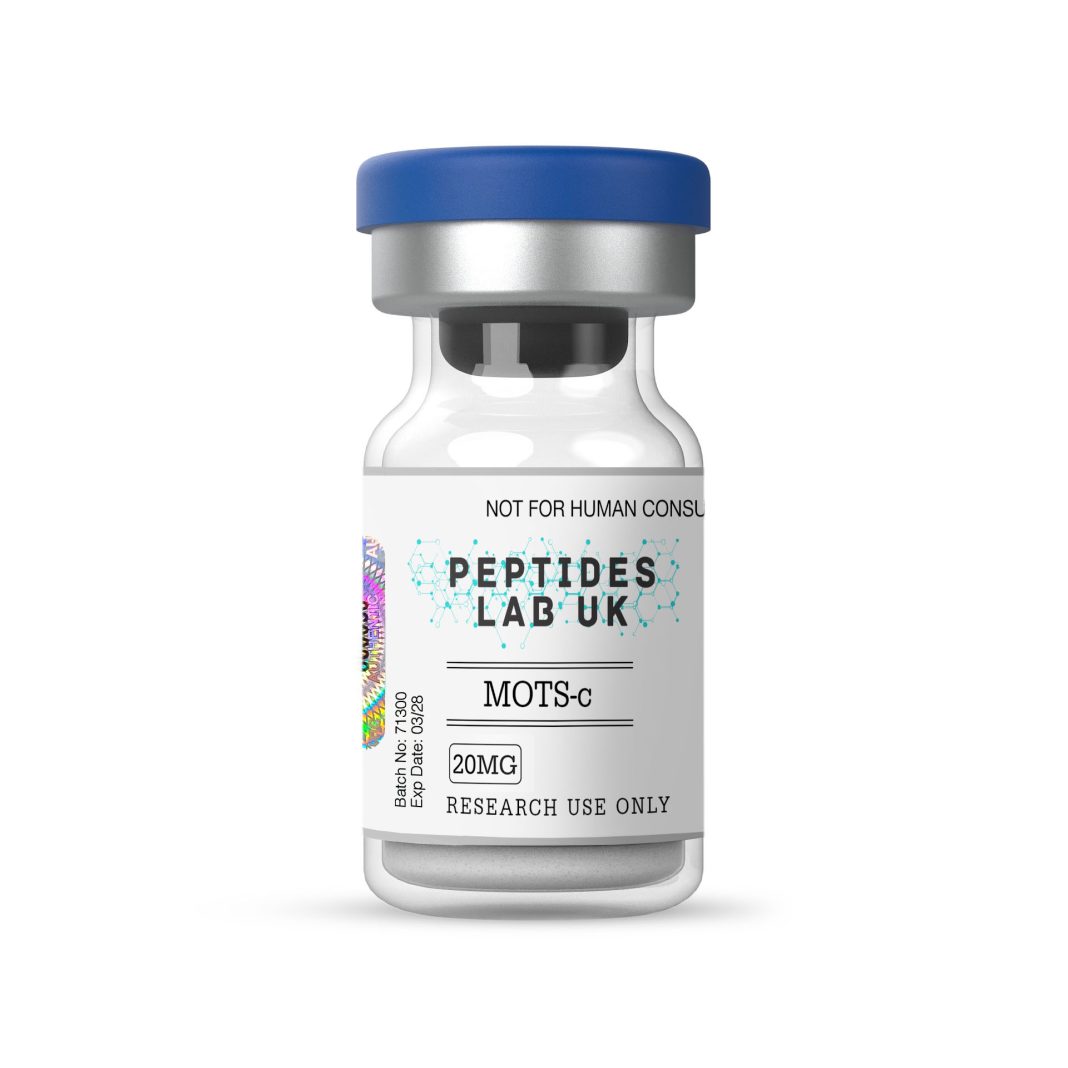

MOTS-c is a mitochondrially derived peptide (MDP) encoded within the short open reading frame of the mitochondrial 12S rRNA gene, distinguishing it from the vast majority of cellular peptides and proteins, which are encoded by nuclear DNA. First identified in 2015, MOTS-c is significant to metabolic research because it represents a class of signalling molecules that originate from the mitochondrial genome itself rather than from the nucleus, and because it has been shown to translocate to the nucleus under conditions of cellular stress to directly regulate nuclear gene expression. Within laboratory research, Mots c peptide is used extensively to study mitochondrial-nuclear communication, AMPK-dependent energy signalling, and cellular adaptation to metabolic stress in skeletal muscle and other tissue models.
What Is MOTS-c Peptide?
MOTS-c (mitochondrial open reading frame of the 12S rRNA type-c) is a 16-amino-acid peptide with the sequence MRWQEMGYIFYPRKLR, encoded by a short open reading frame (sORF) located within the mitochondrial 12S ribosomal RNA gene. Its discovery followed the earlier identification of humanin, another mitochondrially encoded signalling peptide, which prompted researchers to search for additional sORFs within mitochondrial DNA capable of producing bioactive peptides. This sORF biology is a relatively recent area of molecular biology, since mitochondrial DNA had historically been assumed to encode only the core proteins required for oxidative phosphorylation, rather than additional regulatory signalling molecules.
Under baseline cellular conditions, MOTS-c is understood to be present in both the cytoplasm and, to a lesser extent, associated with mitochondria, reflecting its site of translation and its origin from mitochondrial genetic material. What distinguishes MOTS-c from most other characterised mitochondrial-derived peptides is its behaviour under conditions of metabolic or oxidative stress. Research using cultured cells subjected to glucose restriction, serum deprivation or oxidative stress has demonstrated that MOTS-c undergoes stress-induced translocation from the cytoplasm into the nucleus, a movement dependent on AMPK activity and associated with the transcriptional coactivator PGC-1α. This nuclear translocation is considered a defining and unusual feature of MOTS-c biology, since it represents a direct route by which a mitochondrially encoded peptide can influence nuclear gene transcription, a form of mitochondria-to-nucleus retrograde signalling that had not been well characterised for other MDPs prior to MOTS-c research.
Once inside the nucleus, MOTS-c has been shown to interact with regulatory regions containing antioxidant response elements (AREs), influencing the expression of genes involved in cellular stress adaptation and antioxidant defence. Cellular localisation studies distinguishing nuclear (NUC), cytoplasmic (CYTO) and mitochondrial (MITO) protein fractions, using markers such as Lamin B1 for the nuclear fraction, GAPDH for the cytoplasmic fraction and VDAC for the mitochondrial fraction, have been used to confirm this stress-dependent redistribution in skeletal muscle tissue following exercise challenges in animal models. This body of localisation work is central to understanding MOTS-c not simply as a circulating metabolic hormone but as a dual-function molecule capable of both extracellular signalling and direct intranuclear gene regulation.
Mechanism of Action
The principal mechanism attributed to MOTS-c in the published literature is activation of AMP-activated protein kinase (AMPK), the master cellular energy sensor responsible for coordinating metabolic responses to energy stress. Unlike many metabolic peptides that act through direct receptor binding at the cell surface, MOTS-c is understood to activate AMPK indirectly, through modulation of the cellular folate cycle and its associated de novo purine biosynthesis pathway. Specifically, MOTS-c has been reported to inhibit the folate cycle, which reduces de novo purine synthesis and produces a localised rise in AICAR (5-aminoimidazole-4-carboxamide ribonucleotide), an endogenous purine intermediate that directly phosphorylates and activates AMPK. This Folate-AICAR-AMPK pathway is the central mechanistic axis through which MOTS-c is believed to exert its downstream metabolic effects, and it distinguishes MOTS-c mechanistically from pharmacological AMPK activators such as metformin, which acts primarily through inhibition of mitochondrial complex I, or direct AMPK agonists, which do not rely on folate cycle modulation at all.
Once activated, AMPK signalling downstream of MOTS-c has been associated with several further effects relevant to laboratory research. Phosphorylation of AMPKα2 at Thr172, along with phosphorylation of acetyl-CoA carboxylase (ACC) at Ser79 and elevated carnitine palmitoyltransferase-1 (CPT-1) protein levels, have been reported in skeletal muscle cell models following MOTS-c administration, consistent with increased fatty acid oxidation capacity. AMPK activation downstream of MOTS-c has also been linked to increased glucose transporter (GLUT4) translocation to the plasma membrane in skeletal muscle cell models, a mechanism proposed to underlie reported effects on cellular glucose uptake in this tissue type. Additional downstream signalling has been reported through activation of SIRT1 and PGC-1α, transcriptional regulators associated with mitochondrial biogenesis and broader energy homeostasis, positioning AMPK activation as a hub through which MOTS-c connects folate cycle modulation to longer-term adaptive changes in cellular metabolic capacity.
The nuclear gene regulation component of MOTS-c’s mechanism operates in parallel to its cytoplasmic AMPK-activating effects. Following AMPK-and PGC-1α-dependent nuclear translocation under stress conditions, MOTS-c has been reported to bind at or near genomic regions containing antioxidant response elements, influencing the transcription of stress-adaptation genes. Reported downstream transcriptional targets identified in the literature include GLUT4, STAT3 and IL-10, linking MOTS-c’s nuclear activity to glucose transport regulation, cytokine signalling and inflammatory modulation respectively, although researchers have noted that a comprehensive account of the full transcriptional network regulated by nuclear MOTS-c remains an active area of investigation rather than a fully settled picture.
What the Research Shows
The foundational characterisation of MOTS-c was published by Lee and colleagues, who first identified the peptide encoded within the mitochondrial 12S rRNA sORF and demonstrated that its cellular actions inhibit the folate cycle and associated de novo purine biosynthesis, leading to AMPK activation with skeletal muscle identified as its primary target tissue. In this study, MOTS-c treatment prevented age-dependent and high-fat-diet-induced insulin resistance as well as diet-induced obesity in mouse models, and increased phosphorylation of AMPKα2 and ACC was observed following 72 hours of MOTS-c treatment in cell culture (mitochondrial-derived peptide discovery study).
Building on this discovery, Kim and colleagues used cultured cell models subjected to metabolic stress, including glucose restriction and serum deprivation, to demonstrate that MOTS-c translocates from the cytoplasm to the nucleus in an AMPK-dependent manner, where it regulates the expression of nuclear genes containing antioxidant response elements. This study was among the first to establish MOTS-c as a peptide capable of direct nuclear gene regulation, a function not previously well documented for mitochondrially encoded signalling molecules (nuclear translocation study).
A broader review of the MOTS-c literature summarises the retrograde signalling pathway from mitochondria to nucleus and consolidates findings across energy metabolism, stress homeostasis and aging-related research, noting that MOTS-c is significantly expressed in response to both stress and exercise and that its activity through the Folate-AICAR-AMPK pathway has downstream implications for insulin resistance and inflammatory signalling across multiple published preclinical models (MOTS-c mechanism and aging review).
Exercise-focused research has separately established that MOTS-c expression is induced by physical activity. Studies using rodent models have reported that MOTS-c protein is present in skeletal muscle at baseline and undergoes measurable subcellular redistribution following downhill running and other exercise challenges, with systemic administration of exogenous MOTS-c shown to improve acute exercise performance in mouse models. Circulating MOTS-c levels have also been reported to decline with age in human subjects, with one comparative study reporting substantially lower circulating levels in older adults relative to younger subjects, a finding that has motivated a distinct line of research into MOTS-c’s potential relevance to age-related metabolic decline in preclinical models.
Lipid regulation has also featured in the published literature, with AMPK-dependent effects on fatty acid oxidation, reflected in elevated CPT-1 protein levels and ACC phosphorylation, reported alongside the compound’s effects on glucose handling, suggesting that MOTS-c’s metabolic actions in skeletal muscle cell and animal models extend across both carbohydrate and lipid metabolism pathways rather than being confined to a single metabolic axis.
Research Applications
Within laboratory settings, MOTS-c research peptide is used across several distinct experimental contexts. Skeletal muscle cell cultures represent the most extensively studied application, reflecting the tissue’s identification as MOTS-c’s primary target organ, where researchers examine AMPK phosphorylation, glucose transporter translocation and mitochondrial bioenergetic parameters following peptide exposure. Metabolic dysfunction assays, typically conducted in rodent models of diet-induced obesity or age-related insulin resistance, are used to study systemic effects on glucose tolerance and body composition, administered under controlled preclinical protocols consistent with the published literature.
Nuclear gene expression profiling constitutes a further significant research application, in which researchers examine MOTS-c’s stress-induced nuclear translocation and its downstream effects on transcription of genes associated with antioxidant response elements, using techniques such as subcellular fractionation and quantitative PCR to characterise this mitochondria-to-nucleus signalling axis. Mitochondrial retrograde signalling protocols more broadly encompass the study of how mitochondrially encoded peptides such as MOTS-c communicate cellular energy status to the nucleus, a research area that extends beyond MOTS-c alone to encompass related mitochondrial-derived peptides such as humanin and the small humanin-like peptides. When selecting a certified MOTS-c research peptide for cellular assay protocols, researchers should confirm the exact 16-amino-acid sequence and purity documentation supplied, since sequence accuracy is essential to reproducing the AMPK-activation and nuclear-translocation findings reported in the primary literature.
Comparative pharmacology work has also used MOTS-c alongside established AMPK-activating compounds such as metformin, given their convergence on the same downstream kinase through distinct upstream mechanisms, providing researchers with a useful comparative framework for studying folate-cycle-dependent versus complex-I-dependent routes of AMPK activation in cell and animal models.
Purity, Storage and Handling
Research-grade MOTS-c should be accompanied by a certificate of analysis confirming purity by HPLC, typically at or above 98 percent, together with mass spectrometry verification confirming the correct 16-amino-acid sequence and molecular weight. Because much of the published mechanistic literature relies on precisely defined AMPK-activation and nuclear-translocation assays, even minor sequence variation or degradation in a supplied batch can materially affect the reproducibility of findings drawn from the primary research. When sourcing high-purity Mots c peptide for laboratory research, UK researchers should verify that each batch includes this documentation rather than relying on a generic product listing, and should request batch-specific data wherever possible.
Lyophilised MOTS-c should be stored at -20°C, protected from light and moisture, in order to preserve peptide integrity prior to reconstitution. Once reconstituted, the peptide should be handled promptly, since reconstituted peptide solutions are generally more susceptible to degradation through oxidation, hydrolysis and repeated freeze-thaw cycling than the lyophilised form. Aliquoting reconstituted material into single-use volumes is recommended to minimise freeze-thaw exposure, and reconstituted solutions should be kept refrigerated at 2-8°C and used within the supplier’s stated stability window. Researchers should also select a reconstitution buffer appropriate to the specific assay being performed, since buffer composition can influence peptide stability and, in some cell-based assay systems, the solvent vehicle itself may need to be accounted for as an experimental control.
Frequently Asked Questions
What makes MOTS-c different from other mitochondrial-derived peptides?
MOTS-c is encoded by the mitochondrial 12S rRNA gene, distinguishing it from humanin and the small humanin-like peptides, which are encoded by the 16S rRNA gene. MOTS-c was the first mitochondrial-derived peptide demonstrated to translocate directly into the nucleus and regulate nuclear gene expression, a function not established for the other characterised MDPs at the time of its discovery.
How does MOTS-c activate AMPK if it does not bind a cell-surface receptor?
Published research indicates that MOTS-c inhibits the cellular folate cycle and its associated de novo purine biosynthesis pathway, producing a localised increase in AICAR, an endogenous molecule that directly phosphorylates and activates AMPK. This indirect, metabolite-mediated mechanism distinguishes MOTS-c from receptor-binding peptide hormones and from AMPK activators that act through other pathways, such as mitochondrial complex I inhibition.
Under what conditions does MOTS-c translocate to the nucleus?
Cell culture studies have shown that MOTS-c undergoes nuclear translocation under conditions of metabolic stress, including glucose restriction, serum deprivation and oxidative stress, in an AMPK- and PGC-1α-dependent manner. Animal studies have similarly reported nuclear redistribution of MOTS-c in skeletal muscle following exercise challenges such as downhill running protocols.
How should research-grade MOTS-c be verified before use in an assay?
Researchers should request a batch-specific certificate of analysis confirming HPLC purity of 98 percent or higher and mass spectrometry confirmation of the correct 16-amino-acid sequence, since sequence accuracy is essential to reproducing the AMPK-activation, glucose-transporter and nuclear-translocation findings reported across the primary literature.
Mots c peptide, as supplied by Peptides Lab UK and comparable UK research suppliers, is intended strictly for in-vitro and animal-model laboratory research. It is not licensed or intended for human or veterinary use, and nothing in this article should be interpreted as guidance for personal administration.