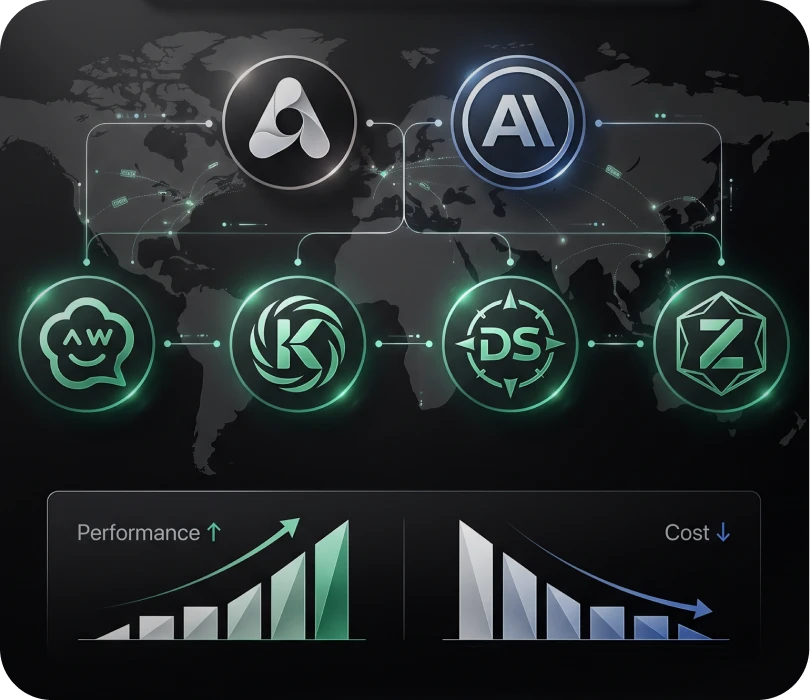

A single agentic AI interaction can cost anywhere from a fraction of a cent to several dollars, and the gap between those two numbers is almost entirely about what the agent does after it reads your prompt. A simple chatbot reply is one pass through a model. An agentic interaction is a loop: the model plans, calls tools, reads results, reconsiders, and sometimes tries again. Each extra step re-sends context, and that context is what drives the bill.
If you have ever tried to budget for an AI agent rollout and watched the number balloon well past your pilot estimate, you are not imagining it. Teams that understand the realagentic AI cost per interaction build more predictable systems, choose the right models for the right tasks, and avoid the budget shock that has hit even well-resourced engineering organizations this year. This guide breaks down where the money actually goes, why open-weight models change the math, and how to keep agentic costs under control without giving up on the technology.
Why Agentic Interactions Cost More Than Chat
A standard chatbot exchange is a single request and a single response. You send a prompt, the model reads it, and it writes back. The token count is modest and predictable.
An agentic interaction is different because it is not one request. It is a chain of requests strung together by a task the agent is trying to complete. A support agent resolving a ticket might read the customer’s history, search a knowledge base, draft a reply, check that reply against policy, and only then respond. A coding agent fixing a bug might read several files, run tests, interpret the failure, and revise its patch two or three times before it succeeds.
Every one of those steps typically resends the accumulated conversation history along with any new tool output. That is why industry estimates consistently put agentic workloads at several times the token consumption of a simple prompt-and-response exchange, and in the most tool-heavy cases, such as coding agents that repeatedly re-read large codebases, the multiplier can be dramatically higher. The autonomy that makes agents useful is the same autonomy that makes them expensive.
The Loop Is the Cost Driver
Three things determine how expensive an agentic loop becomes:
- Number of turns. Each additional planning, tool-call, or retry step adds another round trip to the model.
- Context size. Long conversation histories, large tool outputs, and big codebases all get re-sent on every turn unless the system is built to avoid it.
- Model choice. Reasoning-heavy models cost more per token and often generate longer outputs, which compounds the effect of a multi-turn loop.
A ten-turn agent session does not simply cost ten times a single call. Because context accumulates with each turn, the growth curve is steeper than linear, which is why costs can surprise teams that only modeled per-token pricing rather than per-task token volume.
What a Real Interaction Actually Costs
Published estimates vary widely because “an interaction” means different things depending on the workload. A few patterns show up consistently across cost analyses from enterprise AI teams and infrastructure vendors:
- Simple, low-tool workflows such as a scripted FAQ response or a single lookup can cost a fraction of a cent per interaction.
- Moderately complex agents, like an HR onboarding assistant or a basic customer support bot that calls one or two tools, tend to land in the range of a few cents per interaction, adding up to roughly a few thousand dollars a year for a lightweight, steadily used agent.
- Heavily orchestrated systems, involving multiple tools, iterative reasoning, and retries, can run well over a dollar per interaction, and complex coding or research agents can cost several dollars for a single completed task.
UnderstandingAgentic AI Costs at this level of detail matters because averages hide the outliers that blow up budgets. A team that models cost per simple interaction and ignores the long tail of complex, multi-step tasks will consistently underestimate its actual spend. Enterprises deploying agentic systems at scale have reported exceeding their original cost projections specifically because the pilot workloads did not reflect the token volume of production usage, where multi-step loops run continuously rather than occasionally.
The lesson is not that agentic AI is unaffordable. It is that cost modeling needs to happen at the task level, not the token-price level. A cheap per-token rate on a model that requires twenty tool calls to finish a job can end up more expensive than a pricier model that finishes the same job in five.
Open-Weight Models and the Cost Equation
Open-weight models have become a serious lever for managing agentic AI costs, but the relationship is more nuanced than “open equals cheaper.”
Hosted Open-Weight APIs
The simplest way to use an open-weight model is through a hosted provider that runs the infrastructure for you and charges per token. This approach typically offers meaningfully lower per-token rates than premium proprietary APIs, without requiring any operations work. For teams with variable or unpredictable agentic workloads, this is usually the right starting point, since it avoids paying for idle infrastructure during quiet periods.
Self-Hosting Open-Weight Models
Self-hosting looks attractive on paper because the model weights themselves are free. In practice, the total cost of ownership includes GPU rental or purchase, serving infrastructure, engineering time to maintain the stack, and the cost of keeping utilization high enough to justify the hardware. Cost analyses generally find that self-hosting only becomes cheaper than a managed API once monthly token volume is high and, crucially, steady. Bursty or unpredictable agentic traffic tends to leave expensive GPUs idle, which erodes the savings self-hosting is supposed to deliver.
A useful rule of thumb that shows up across infrastructure cost breakdowns: use a hosted API for variable volume, consider self-hosting for high and steady volume, and use small local models for narrow, privacy-sensitive, or offline tasks where raw capability matters less than control over the data.
Where Open-Weight Models Actually Help
The real opportunity for open-weight models in agentic systems is not blanket cost cutting. It is task-level routing. Not every step in an agentic loop needs a frontier reasoning model. Planning and complex synthesis steps may benefit from a stronger model, while routine tool-calling, formatting, or simple classification steps can often run on a smaller, cheaper open-weight model without hurting task quality. Teams that have implemented this kind of routing have reported meaningful reductions in monthly spend without changing what the agent actually does for the user.
Practical Ways to Control Agentic AI Costs
You do not need to abandon agentic workflows to control their cost. A few concrete levers make the biggest difference in practice.
1. Use Prompt Caching
Repeated system prompts, tool definitions, and large context blocks that get resent on every turn are prime candidates for caching. Marking stable portions of a prompt as cacheable can cut the cost of those tokens substantially on subsequent calls within the same session, which matters enormously in multi-turn agentic loops where the same context is resent again and again.
2. Route Tasks by Complexity
Not every subtask in an agent’s workflow requires the most capable, most expensive model available. Routing simple steps, like formatting a response or extracting a field from a document, to a smaller or open-weight model while reserving frontier models for genuine reasoning steps is one of the most effective cost controls available, and it does not require rebuilding the agent’s logic.
3. Cap Loop Length
Agentic loops that are allowed to retry indefinitely can silently consume enormous token volumes on tasks that were never going to succeed. Setting a maximum number of turns or tool calls per task, with a clear fallback or human handoff, protects the budget without limiting the agent’s usefulness on the tasks it can actually complete.
4. Monitor Cost Per Task, Not Just Per Token
Per-token pricing tables do not tell you what a completed task costs. Tracking cost per resolved ticket, per merged pull request, or per completed workflow gives a far more accurate picture of where the money is going and which tasks are worth automating at all.
5. Right-Size Context
Sending an entire codebase, document, or conversation history on every turn is often unnecessary. Retrieval-based context, summarized history, or targeted tool outputs can dramatically reduce the token volume per turn without sacrificing the agent’s ability to complete the task correctly.
Building Cost-Aware Agentic Systems
The organizations getting the most value from agentic AI in 2026 are not the ones chasing the cheapest per-token rate. They are the ones that treat cost as a design constraint from the start, choosing model tiers deliberately, capping loops, caching aggressively, and mixing open-weight and proprietary models based on what each task actually needs. Echo-Me works with teams building exactly this kind of cost-aware agentic infrastructure, helping them model realistic workloads before deployment rather than discovering the real numbers on an invoice. That kind of upfront planning is what separates agentic AI projects that scale sustainably from the ones that quietly blow through their annual budget in a single quarter.
If you are still asking how much does an agentic AI interaction cost for your specific use case, the honest answer is that it depends far more on the number of steps in your agent’s loop than on which model you pick. Getting that architecture right, before scaling usage, is the single highest-leverage decision you can make.
Frequently Asked Questions
1. What is the average cost of a single agentic AI interaction? It ranges widely, from a fraction of a cent for simple, low-tool tasks to several dollars for complex, multi-step workflows like coding or research agents. The task’s number of steps and tool calls matters more than the base per-token price.
2. Why do agentic AI interactions cost more than chatbot conversations? Agentic interactions involve multiple rounds of planning, tool use, and revision, and each round typically resends accumulated context. A chatbot reply is one pass through a model, while an agent’s task can involve many passes chained together.
3. Are open-weight models actually cheaper for agentic AI? Hosted open-weight APIs are usually cheaper per token than premium proprietary APIs. Self-hosting only becomes cost-effective at high, steady volume, since idle GPU capacity and operational overhead can erase the expected savings.
4. How can I reduce agentic AI costs without losing functionality? Cache repeated context, route simple subtasks to smaller or open-weight models, cap the number of retries per task, and track cost per completed task rather than cost per token alone.
5. Does model choice matter more than agent design for controlling costs? Agent design usually matters more. A cheaper model that needs many extra steps to finish a task can end up costing more than a pricier model that completes the same task efficiently in fewer turns.
6. What is prompt caching and how does it lower agentic AI costs? Prompt caching lets you mark stable parts of a prompt, like system instructions or tool definitions, so they are charged at a reduced rate on repeated calls within a session. This matters especially in agentic loops that resend the same context on every turn.
7. How do I estimate agentic AI costs before deploying at scale? Model your expected task volume, the average number of steps per task, and realistic context size per step, then test against production-like scenarios rather than simplified pilots, since pilot workloads often understate real token consumption.
8. Is self-hosting an open-weight model worth it for a small team? Usually not. Self-hosting requires sustained, high, and predictable volume to offset infrastructure and engineering costs. Most small teams get better economics from a hosted API, whether proprietary or open-weight.